
A Queer Dander 2025 and Flippin’over the table 2026
Documentary film, and exhibition at The MAC Belfast
Commissioned by The MAC, and Belfast Pride
The article below commissioned by Inherent Vice 2026
A Queer Dander by Thomas Wells
In June 1991, 100 brave souls marched through the streets of Belfast marking the first Belfast pride event ever seen in the city. A moment of celebration, a f**k you to the religious establishment as the gathering proudly announced, ‘we’re here, we’re queer, get used to it!’...Or at least, this is how I imagined it to be, just that simple!
The reality was perhaps not so simple, amidst the traditionalism of embedded Irish social politics in a city that was still in the wake of the period commonly referred to as ‘The Troubles’ all citizens of the region lived in a constant state of alert. For context, Belfast is a city that is still divided physically by metal and concrete barriers that forcibly separate communities from each other. When I first moved to the city, having to navigate the opening and closing of interfaces to get from one side to another took advanced planning, especially when taxiing through with visitors with GPS systems not knowing the gates opening hours.
Through the cracks of these divisions, it is suggested that the LGBTQIA+ community thrived, that those more attuned to the shadows and the glow of neon lights made the most of the abandoned night economy, it would have been deemed too dangerous to enter the city centre at night. They were able to exist in relative peace. The binaries of oppression between Catholic and Protestant, Nationalist and Republican simply didn’t matter when everyone hated the queers!
Depending on who you speak to, or where you get your sources there were about 50-150 people on that premier march, ‘A rent a mob of socialists’ according to one eloquent witness which was organised by the Northern Ireland Gay Rights Association (NIGRA). This group formed in 1975 to campaign against the criminalisation of homosexuality and were fuelled by their counterparts in the south (the first Dublin pride was 1983) to host this event on the very public streets of Belfast.
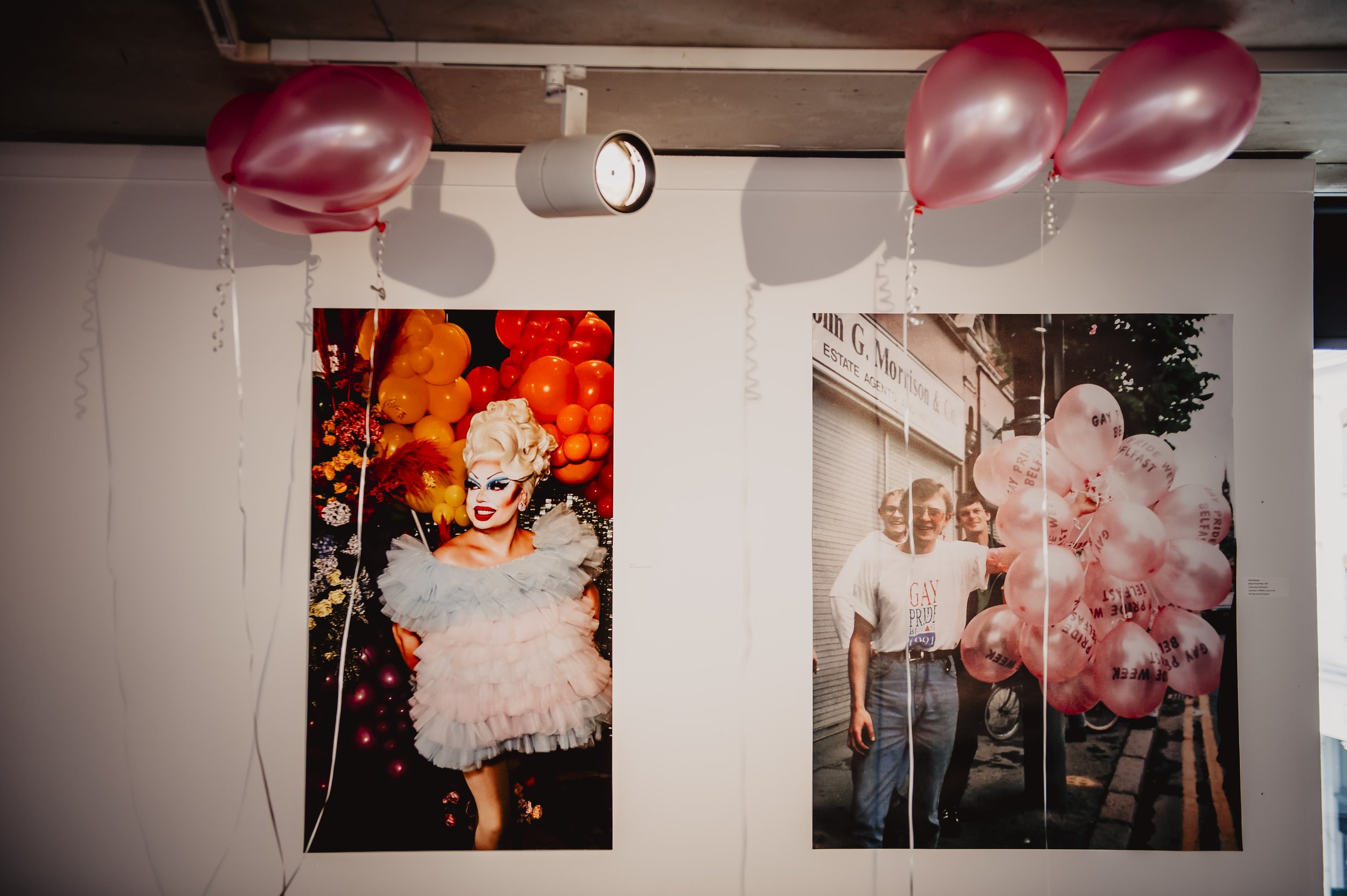
Thirty four years later a moustachioed artsy blow-in was invited by The MAC and Belfast Pride to build an exhibition around the history of Pride since 1991 through memorabilia. Discounting maybe a couple of years in-between, Belfast has hosted an ever growing Pride festival and parade with record numbers being recorded in 2018 during the campaign for the extension of the equal marriage act, which was finally extended the following year. It has seen a growing level of commercialisation, like all prides, as well as its own controversial decisions that have seen the ban of uniformed police being able to march in a response to historic police brutality by the PSNI towards the LGBTQIA+ community, and the removal of major political parties; Sinn Fein, DUP (not that they would anyway) Alliance and SDLP from taking part.
Through researching the history of Pride in Belfast, objects or memorabilia did not successfully represent the nuance of the experience of the community. Without the voices of the people that infused them, objects felt flat, silenced and dehumanised. This was not the reality of the queer community that was loud, active, and continuing to push the systems of oppression that are unfortunately still making life challenging. A Queer Dander was the culmination of this research, which opened at The MAC (The Metropolitan Arts Centre) as part of their pride programme in 2025. Central to this was a documentary produced in collaboration with artist and film-maker Niamh McCann. Together we had interviewed six invited participants on their memories and experiences of pride in Belfast from 1991-2024. These participants were; Ruth McCarthy the artistic director of Outburst Arts and Outburst Queer Arts Festival, local activist Tina McCombe, Richard O’Leary an artist and storyteller, Electra La C**T drag queen extraordinaire, Shogher Maria Doghramajian a PhD Researcher at Queen’s University Belfast and artist Charlie Beare.
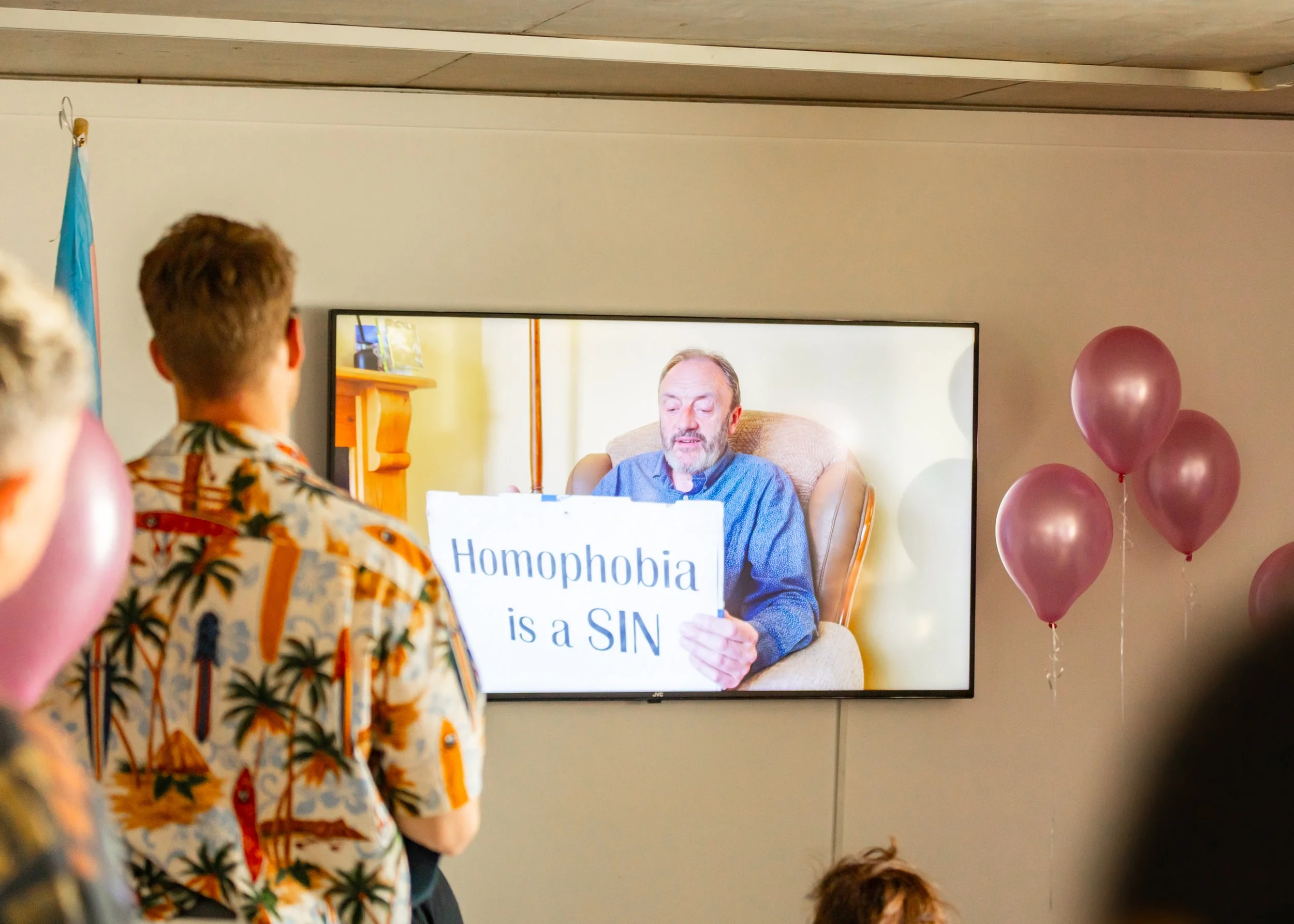
These individuals represented key moments of celebration or friction in the history of pride, moments that rippled beyond the parade and the festival and spoke to the wider more intersectional issues affecting Belfast, and the north of Ireland with its complex social and political challenges. Ruth McCarthy, present at the first pride march, and an established activist who had moved to Belfast from Limerick, talks about how pride as a concept has and needs to continue to evolve to readdress its value in representing the community. She goes on to explain, with an insight into global perspectives of pride, how Pride has to continue to challenge itself within unique jurisdictions. Controversial activist, Tina McCombe whose personal archive is now part of the National Museum Northern Ireland modern history collection, talks to us about the importance of acceptance, stating that the best Belfast Pride was in 1999 when there was an invitation into the City Hall by the then Deputy Lord Mayor Marie Moore. Tina’s jacket, a leather studded biker jacket with the words, ‘DYKE BITCH FROM HELL’ on the back featured in the film and acts as a reminder of continued resistance against hostility. In an touching account of life with his partner, storyteller and self-identifying ‘fairy from Cork’, Richard O’Leary tells us a story about the time he was mistaken for a Christian protestor by a sign that read HOMOPHOBIA IS A SIN by police directing him to the anti-gay protestors that are a continued presence in Belfast. The police officer after a second reading of the sign realised their mistake. As a proud gay Christian, Richard talks about the importance of finding community in faith.
Drag Queen, Electra La C**T who fought a very public battle with the politician Jim Wells in 2017 after taking part in Pride, giving visibility to those living with HIV/AIDS by wearing a constructed tiara of hypodermic needles filled with HIV+ blood. This act that resurrected misinformation about transmission and life expectancy ignited by right-wing bigotry, culminated in the iconic speech at Stormont during Alternative Miss Pride, the first event of its kind organised by the now leader of the Green Party in Northern Ireland, Mal O’Hara. Electra in full drag and beat glided down the staircase of the main hall and delivered a speech calling out the bigots and the bullies ending in a chant of ‘UPPA QUEERS’ a phrase that should still ring in the halls of the establishment as much as it does in the ears of those that were there to hear it.
Following what we thought at the time were the worst race riots in the city in 2024, Shogher Maria Doghramajian talks about her experience of her first Pride in Ireland the comparisons to this globally from her unique experience. Shogher also confronts us with what it is like being an openly queer person of colour in Belfast, and indeed Northern Ireland and finding community within marginalised groups with Rainbow Refugees. Finally, artist Charlie Beare shines a light on the hypocrisy of Pride, politicians and certain sections of the community that turned their back on our trans siblings after marching proudly under the banner ‘Stand By Your Trans’ the theme of the 2024 Pride. Charlie leaves us with a final optimistic thought for the future, that we can take the negativity and do something with it, take it, and use it.
All of these accounts and stories highlighted the increased importance for intersectional and marginalised voices from within our community to be shared loudly in our public spaces. Ruth McCarthy in her interview talks about the early days of Pride, and the movement that led to the march. The roots of queer liberation never being about marriage, it was about equality. Ruth challenges this by asking, ‘equality with what?’ At the same time, Electra offers another provocation about the future for LGBTQIA+ peoples, angry that we have been symbolically offered a seat at the table, she wants to flip the entire table over. We do not want to be handed the rights we deserve, we want to take them!
These provocations on the future for LGBTQIA+ communities in Ireland and globally have initiated a research PhD that I am currently undertaking at The Belfast School of Art. The research is focused on the question of whether pride in its current capacity represents the collective LGBTQIA+ community, and if not how does it change. As well as this, looking at the causes that instigated the first liberation marches after Stonewall, and whether the roots of protest and resistance need to be reconnected, especially in light of the rise of the far-right globally and the pulling back of LGBTQIA+ rights and visibility.
A Queer Dander, was extended due to its popularity and ran for four weeks in the gallery. Following this, I continued to convene with Belfast Pride and The MAC as we moved towards the 35th year anniversary of Pride in Belfast in 2026. To develop a longer term plan of how to memorialise the histories and stories of this legacy, especially how we tackle targeted attacks on our community, the continued attempts to eradicate LGBTQIA+ visibility in arts and culture. Flippin’over the table, has now become the extension of A Queer Dander and features the work and contributions of the community in thinking about the past, present and future. These initial workshops will culminate in an exhibition for Belfast Pride 2026 with the allyship of The MAC. Central to this is a co-created work imagining a new queer superhero that can act as our future protector. What would an LGBTQIA+ superhero look like, what would their origin story be, what powers would they have, and how would they use those powers? To find out, the exhibition will open on the 16th July as part of The MAC’s pride celebrations.
Film Credits:
Producer and interviewer: Thomas Wells, Producer and Camera operator: Niamh McCann, Editor: Shaun Doogan, Music: Liam McCartan
Thanks to The MAC and National Museums Northern Ireland